Jupiterswap: Solana Swap Aggregator Features and Fees
Jupiterswap Is a Solana Swap Aggregator Guide
Jupiterswap Is a Solana swap aggregator that helps users compare routes across decentralized exchanges and execute token swaps from one interface. Instead of acting like a single liquidity pool, Jupiterswap looks across available Solana liquidity sources, estimates price impact, applies slippage settings, and presents a route before the user signs a wallet transaction. It can be useful for simple SOL-to-token swaps, stablecoin trades, limit orders, dollar cost averaging, and checking how execution may differ between routes.
Jupiterswap is often searched by people who want to understand whether it is a decentralized exchange, a wallet, a trading bot, or a broader Solana DeFi tool. The simplest answer is that Jupiterswap functions as a routing layer. It connects a wallet to liquidity that may live on different Solana protocols, then attempts to find a practical path for the trade. The user still controls the wallet approval, and the final transaction details should be reviewed before signing.
What is Jupiterswap?
Jupiterswap is commonly used as shorthand for the Jupiter swap experience on Solana, especially by users looking for token swaps through the jup.ag ecosystem. In everyday terms, Jupiterswap is not best understood as a traditional exchange with one order book or one pool. It is better described as an aggregator that searches across decentralized liquidity venues and routes a swap through the path that appears most efficient at that moment.
Jupiterswap matters because Solana has many liquidity sources. A token pair might trade on an automated market maker, a concentrated liquidity pool, an order book style venue, or a combination of pools. If a user checks only one exchange, the quote may not reflect the best available route. Jupiterswap reduces that friction by scanning multiple options and showing a route that may split a trade across more than one source.
Jupiterswap also sits in a broader DeFi workflow. A person may use a Solana wallet, hold SOL for network fees, compare token prices, set slippage tolerance, and then confirm a swap. More advanced users may also look at limit orders, recurring buys, portfolio views, bridging, or launch-related tools where available. These features can be helpful, but they also make it important to understand transaction details rather than clicking through quickly.
How does Jupiterswap route a trade?
Jupiterswap begins with the token pair, trade size, wallet network, and current liquidity conditions. When a user enters a swap, the aggregator estimates how much of the output token the user may receive. That estimate can change quickly because liquidity, token prices, block conditions, and other trades on Solana can move between quote generation and transaction confirmation.
The protocol may route a swap through one liquidity source or split it across several. For example, a large trade may cause too much price impact in a single pool, while several smaller route segments may produce a better combined quote. Jupiterswap presents that routing logic in a user-friendly way, but users should remember that the quote is still an estimate until the transaction is confirmed on-chain.
Jupiterswap routing is especially relevant for tokens with uneven liquidity. Popular pairs such as SOL and major stablecoins may have deep markets, while newer tokens can have thin pools and wider spreads. The aggregator can help compare paths, but it cannot create liquidity where none exists. If a token has poor depth, Jupiterswap may still show high price impact, failed transactions, or routes that are not attractive.
Why do Solana users choose Jupiterswap for swaps?
Jupiterswap appeals to Solana users because it combines price discovery, route comparison, and transaction execution in one flow. Instead of manually opening several decentralized exchanges, a user can enter the desired pair and review the available route. That convenience is one of the main reasons aggregators became important in fast-moving DeFi ecosystems.
Jupiterswap may also help reduce slippage on medium or larger trades when it finds deeper combined liquidity than a single venue can provide. This does not mean every trade will be cheaper or better. Network congestion, token taxes, pool behavior, volatile prices, wallet settings, and liquidity changes can all affect the outcome. Users should treat Jupiterswap as a comparison and execution tool, not as a guarantee of profit.
Common reasons people use Jupiterswap include:
Comparing swap routes across Solana liquidity sources before signing.
Trading SOL, stablecoins, and Solana ecosystem tokens from one interface.
Managing slippage and price impact before confirming a transaction.
Using limit order or DCA-style tools when they fit the user’s plan.
Checking whether a route is available when a single DEX interface feels slow or incomplete.
For a new user, the practical value is less about advanced trading theory and more about avoiding guesswork. Jupiterswap gives a clearer look at available execution paths, but the user remains responsible for deciding whether the trade size, token, and risk level make sense.
How to get started with Jupiterswap
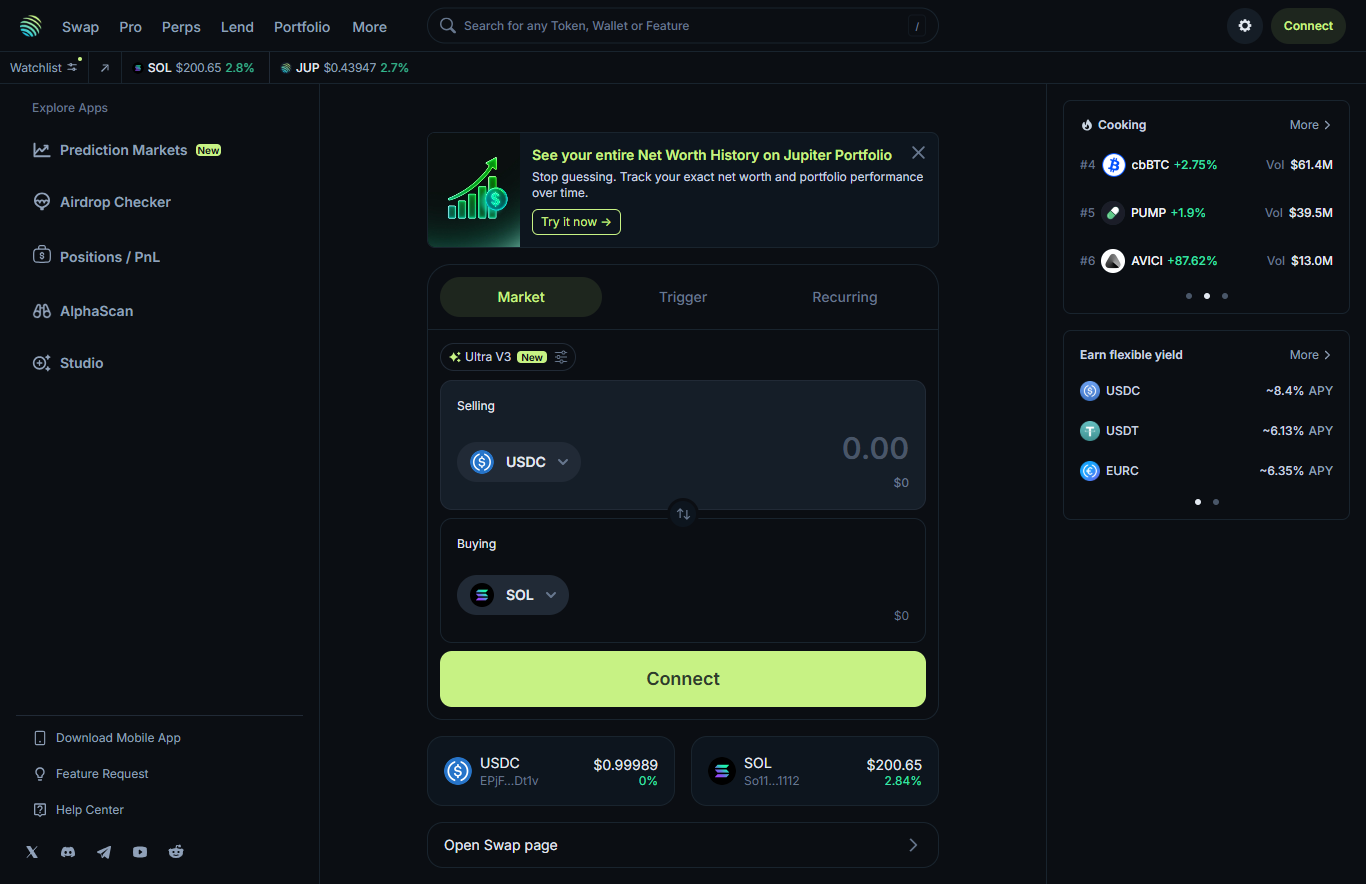
Jupiterswap starts with a compatible Solana wallet and a small amount of SOL for network fees. The user connects the wallet, selects the input token, selects the output token, enters an amount, and reviews the quote. Before confirming, it is important to inspect the route, expected output, minimum received amount, slippage tolerance, and token identity. Similar token names can be misleading, so contract verification matters.
Jupiterswap should be approached in a deliberate sequence. First, confirm that the site or app is the intended official destination. Second, connect a wallet only after checking the URL carefully. Third, choose tokens from verified sources where possible. Fourth, read the transaction prompt in the wallet. Finally, keep enough SOL available for transaction fees and avoid signing transactions that request permissions you do not understand.
A typical Jupiterswap workflow looks like this:
Open the intended swap interface and connect a Solana wallet.
Select the token you want to spend and the token you want to receive.
Enter the amount and review the estimated output.
Check slippage, price impact, route details, and minimum received amount.
Sign only if the wallet prompt matches the action you intended.
Jupiterswap can feel fast, but speed should not replace review. A failed transaction is often cheaper than a rushed mistake with the wrong token, wrong site, or excessive slippage. Users should verify details with official sources and avoid links from unsolicited messages, search ads, or social accounts that cannot be trusted.
Fees and costs of Jupiterswap
Jupiterswap costs are not limited to a single visible number. A user may encounter Solana network fees, liquidity provider fees from routed pools, price impact from the trade size, and any platform-specific fee that may apply to a given product or route. Because these details can change, users should review the live interface and official documentation before making assumptions.
Jupiterswap can sometimes show a better output than using one decentralized exchange directly, especially when routing finds stronger liquidity. However, the lowest apparent fee is not always the best trade if price impact is high or the token is volatile. The meaningful figure is the expected result after route fees, price movement, and slippage limits are considered together.
Cost factor
What it means for a user
Network fee
The small SOL cost needed to process a transaction on Solana.
Pool fee
A fee charged by liquidity sources used in the route.
Price impact
The change in execution price caused by trade size versus available liquidity.
Slippage
The allowed difference between quoted and final execution terms.
Jupiterswap users should pay close attention to the minimum received amount. That number is often more useful than the headline quote because it reflects the worst acceptable execution under the selected slippage setting. For a deeper explanation, a page about can help users understand why a quote may not equal the final result.
Is Jupiterswap safe to use?
Jupiterswap can be part of a safer workflow when users verify the official source, keep wallet permissions under control, and understand the transaction they are signing. Still, no DeFi interface removes crypto risk. Smart contract risk, malicious tokens, fake websites, wallet-draining approvals, unstable liquidity, and market volatility can all lead to losses. Users should never treat Jupiterswap as a risk-free place to trade.
Jupiterswap users should be especially cautious with new tokens. A token may have low liquidity, hidden transfer restrictions, extreme volatility, or misleading branding. Aggregation can help locate a route, but it does not prove that a token is legitimate. Before swapping, users should verify token addresses, review community and project information, and consider whether they can afford the risk.
In practice, safer Jupiterswap habits include using bookmarks for official sites, rejecting unexpected wallet prompts, testing unfamiliar swaps with small amounts, avoiding direct messages that offer support, and keeping a separate wallet for higher-risk activity. Hardware wallets can add another layer of protection, but they do not prevent a user from approving a harmful transaction.
Jupiterswap compared with DEXs, bots, and wallets
Jupiterswap is different from a standalone decentralized exchange because it does not rely on only one pool design. A DEX may specialize in deep liquidity, concentrated liquidity, token launches, or order book style execution. Jupiterswap can route through different liquidity sources where available, which makes it a connector rather than a direct replacement for the underlying venues.
Jupiterswap is also different from a trading bot. Bots may prioritize speed, hotkey execution, automated buying, alerts, or Telegram-based workflows. Those tools can be useful for some active traders, but they introduce their own risks, custody questions, permissions, and learning curves. Jupiterswap is generally easier to understand for a user who wants to compare a route and sign a swap from a wallet interface.
Jupiterswap is not a wallet either. The wallet stores keys, displays balances, and signs transactions. Jupiterswap provides the swap route and transaction request. That distinction matters because a wallet connection does not mean funds have moved. Funds move only when the user signs a transaction that transfers, swaps, approves, or otherwise changes assets on-chain.
For readers comparing Solana tools more broadly, a plain guide to can clarify why aggregators, liquidity pools, and wallet apps serve different roles. Jupiterswap works best when users understand those boundaries before trading.
What can users do with Jupiterswap beyond basic swaps?
Jupiterswap is widely known for token swaps, but many users also associate the Jupiter ecosystem with additional trading and portfolio tools. Depending on current availability, these may include limit orders, recurring purchase strategies, portfolio views, bridging flows, or launch-related pages. Features change over time, so users should verify current details through official sources before relying on any specific tool.
Jupiterswap limit order style tools can be useful when a user wants to target a price instead of accepting the current market quote. DCA-style tools may help users split purchases over time, although they do not remove market risk. Portfolio tools can make holdings easier to inspect, but they should not be treated as tax, legal, or financial advice.
Jupiterswap works best as part of a disciplined process. Users can define the token they want, compare route quality, decide on acceptable slippage, and avoid trading in moments of confusion. The more volatile the token, the more important this discipline becomes. DeFi gives users control, but it also places more responsibility on the person signing each transaction.
Who is Jupiterswap best suited for?
Jupiterswap is useful for Solana users who want a convenient way to compare swap execution without manually checking several liquidity venues. Beginners may appreciate the single interface, while experienced users may value route details, price impact estimates, and advanced order options. The tool can serve both groups, but each user should match the feature set to their own level of understanding.
Jupiterswap may be less suitable for someone who does not understand wallet security, token verification, or transaction signing. It may also be a poor fit for users seeking guaranteed returns, protected deposits, or customer support similar to a regulated centralized platform. Decentralized finance is more self-directed, and mistakes can be difficult or impossible to reverse.
Jupiterswap should be evaluated as infrastructure, not as a promise. It helps users discover and execute routes across Solana liquidity, but it cannot ensure that a token is sound, that a price will move favorably, or that a transaction will always succeed. The right mindset is to verify, test carefully, and treat every signature as an action with real consequences.
Jupiterswap in a practical Solana DeFi workflow
Jupiterswap fits naturally into a workflow where a user researches a token, verifies its address, checks liquidity, reviews the swap route, and signs only after understanding the transaction. That workflow is slower than impulsive trading, but it reduces avoidable mistakes. It also helps users separate the quality of the route from the quality of the asset being purchased.
Jupiterswap can make Solana swaps easier to compare, especially when liquidity is fragmented across venues. Its strengths are routing, convenience, and visibility into execution estimates. Its limits are the same limits that apply across DeFi: volatile markets, smart contract risk, user error, fake links, and uncertain token quality. Used carefully, Jupiterswap can be a practical tool for navigating Solana swaps while keeping risk awareness at the center of the process.
Reader rating:
4.9 / 5
based on 454 ratings
Questions and Answers
What is Jupiterswap used for?
Jupiterswap is used to compare and execute token swaps on Solana through an aggregator-style interface. It searches across available liquidity sources, estimates output, and presents a route before the user signs a wallet transaction. People commonly use it for SOL swaps, stablecoin trades, ecosystem tokens, and checking whether a better route exists than using a single decentralized exchange directly.
Is Jupiterswap the same as a decentralized exchange?
Jupiterswap is better understood as a swap aggregator rather than a single decentralized exchange. A traditional DEX may provide its own liquidity pools or order book, while Jupiterswap can route through multiple Solana liquidity sources. It connects users to available execution paths, but the underlying liquidity may come from different protocols depending on the trade and market conditions.
Does Jupiterswap charge fees?
A Jupiterswap transaction may include Solana network fees, pool fees from liquidity sources, price impact, and any platform-specific costs shown in the live interface. The most important number is often the expected output and minimum received amount after slippage. Because fee structures and routes can change, users should verify current details through the official interface before swapping.
How do I reduce slippage when using Jupiterswap?
To reduce slippage on Jupiterswap, review the route, trade size, liquidity depth, and minimum received amount before signing. Smaller trades may produce less price impact than one large order in a thin market. Users can also adjust slippage tolerance, but setting it too low may cause failed transactions, while setting it too high can allow worse execution than expected.
Is Jupiterswap safe for new crypto users?
Jupiterswap can be approachable for new Solana users, but it still involves self-custody and DeFi risk. Users must verify the official site, check token addresses, understand wallet prompts, and avoid unsolicited links or direct messages. The interface can help with routing, but it cannot guarantee that a token is legitimate or that a trade will be profitable.
What do I need before using Jupiterswap?
Before using Jupiterswap, you need a compatible Solana wallet, enough SOL to pay network fees, and the correct token details for the asset you want to trade. It is wise to start with small transactions, confirm the URL, inspect the quote, and make sure the wallet approval matches the action you intended to perform.
Can Jupiterswap guarantee the best price?
Jupiterswap can compare available routes and may find efficient execution across Solana liquidity sources, but it cannot guarantee the best possible price in every situation. Quotes can change before confirmation, liquidity can move, and volatile tokens may behave unpredictably. Users should treat the displayed route as an estimate and review the final transaction details carefully.
Jupiter Swap acts as a decentralized exchange (DEX) designed for swapping various cryptocurrencies seamlessly. Its growing popularity stems from the innovative solutions it offers for liquidity and transaction efficiency. By leveraging smart contracts, traders can execute transactions at high speeds while maintaining security.
What Sets Jupiter Swap Apart?
The uniqueness of Jupiter Swap lies in its integration with various blockchain networks, offering users flexibility and a wide range of asset options. Unlike centralized exchanges, Jupiter Swap minimizes counterparty risk, which appeals to users looking for more secure trading environments. Additionally, its intuitive design caters to both novice and experienced traders.
Benefits of Jupiter Swap
Opting for Jupiter Swap for trades comes with several advantages:
Lower transaction fees compared to traditional exchanges.
Fast and secure transactions using blockchain technology.
Access to a diverse range of cryptocurrencies and tokens.
User-friendly interface suitable for all skill levels.
Enhanced privacy, as no personal information is required.
How to Use Jupiter Swap
Getting started with Jupiter Swap is straightforward. Users need to connect their crypto wallets, select the trading pair they want, and execute the swap. The platform provides real-time data on prices, making it easier to make informed decisions. It’s recommended to familiarize yourself with the interface and available trading tools to maximize your efficiency.
A Comparison with Other Exchanges
When comparing Jupiter Swap with other trading platforms, several factors come into play, such as fees, supported assets, and user experience. Here’s a quick comparison: