Jupiterswap fees Is a practical guide to costs before swapping
Jupiterswap fees Is mainly a mix of Solana network costs, optional priority or Jito-related costs, and product-specific Jupiter charges that may apply depending on how you trade. Manual market swaps are generally different from Ultra, limit orders, recurring orders, perps, or other Jupiter products, so users should check the transaction preview before signing. The practical answer is simple: review the quoted output, network fee, route, slippage, and any visible commission every time.
Jupiterswap fees matter because a swap price is not only the headline exchange rate. The final result can be shaped by route quality, pool liquidity, transaction priority, token account needs, spread, slippage tolerance, and whether the user chooses an automated mode or a manual mode. Jupiter is widely known as a Solana DEX aggregator, which means it searches across liquidity sources instead of acting like a single order book. That design can help users compare routes, but it does not remove the need to understand cost components.
Jupiterswap fees also need to be separated from token price movement. A user may see a worse final amount because the market moved, because the route changed, because a token is thinly traded, or because a transaction landed later than expected. Those effects are related to trading, but they are not always a platform fee. For any crypto swap, especially one involving volatile or newly issued tokens, users should treat the confirmation screen as the source of truth and verify current details through official Jupiter surfaces.
What is Jupiterswap fees in plain language?
Jupiterswap fees describes the costs a user may face when swapping tokens through Jupiter on Solana. In plain language, it is the difference between the ideal market quote and the real trade outcome after network costs, routing choices, and product rules are included. Some costs are paid to the Solana network, some may be tied to transaction delivery, and some may be charged by Jupiter for specific products or modes.
Jupiterswap fees should not be confused with a traditional centralized exchange fee schedule. A centralized exchange might publish a maker and taker table, hold user balances internally, and settle trades inside its own database. Jupiter works with on-chain wallets and Solana transactions. That means a user often pays for blockchain execution directly, even when the swap interface tries to simplify the process.
Jupiterswap fees are easiest to understand as three possible layers. The first layer is the Solana network fee required to submit and process a transaction. The second layer may be a priority fee or Jito tip when a user selects transaction delivery options intended to improve landing or MEV protection. The third layer may be a Jupiter commission or product fee when using certain features such as Ultra, recurring orders, limit orders, or perpetual trading products.
How does Jupiterswap fees work when Jupiter routes a swap?
Jupiterswap fees work alongside routing. Jupiter looks for an efficient path between the input token and output token, sometimes using one liquidity source and sometimes splitting the trade across multiple venues. The route can include automated market makers, concentrated liquidity pools, order-style liquidity, or intermediate tokens. A better route may offset small network costs, while a weak route can make even a low platform fee feel expensive.
Jupiterswap fees are shown in the context of the quote, not in isolation. A swap preview usually focuses on how much of the output token the user is expected to receive, the price impact, and the trade settings. A small network fee may be less important than a large price impact on an illiquid pair. Likewise, a low commission does not guarantee a good trade if the token route is unstable or the market is moving quickly.
The protocol can also involve slippage settings. Slippage is not a fee paid to the platform; it is the amount of price movement a user is willing to tolerate before the transaction fails or executes within the accepted range. Jupiterswap fees and slippage are often discussed together because both affect the user's realized result. A tight slippage setting can protect against poor execution but may cause failed transactions during fast markets.
Jupiterswap fees may vary by trading mode. Manual mode gives users more direct control over settings such as slippage, transaction broadcasting, and routing choices. Ultra mode is designed to abstract more details and may dynamically handle parts of the transaction flow. Because the fee treatment can differ by mode and product, the correct habit is to read the live quote rather than relying on a remembered fee number.
Which costs are included in Jupiterswap fees?
Jupiterswap fees can include several cost categories, and the most important distinction is whether the charge comes from the blockchain, the delivery path, or a Jupiter product. Solana network fees are required for on-chain activity. These are not the same as a Jupiter commission. They can be small in ordinary conditions, but they still matter because failed or rejected attempts may consume network costs.
Jupiterswap fees may also involve token account creation or rent-related costs in some Solana workflows. A user who has never held a specific token may need an associated token account. Some interfaces abstract that detail, but the transaction preview may still reflect the required on-chain account action. This is one reason two users making similar swaps can see slightly different wallet prompts.
Jupiterswap fees can include priority-related costs when a user wants a transaction to land faster or use a specific broadcast path. Jito tips, priority fees, and MEV-protection choices are not identical concepts, but they all relate to transaction handling rather than the simple exchange rate. Users should avoid assuming those costs are always necessary; they depend on market conditions, wallet behavior, and the selected mode.
Solana network fees for submitting and processing transactions.
Possible priority fees or Jito tips for selected broadcast options.
Jupiter product fees for certain modes, orders, or trading products.
Price impact caused by liquidity depth and route structure.
Slippage tolerance, which affects execution limits rather than acting as a direct fee.
Jupiterswap fees are therefore best evaluated through total cost. A clean quote with low price impact, clear network costs, and transparent settings is usually easier to assess than a route that appears cheap but depends on unstable liquidity. For a broader starting point on the platform, a reader can review the general before focusing on fee details.
Are manual swap costs different from Ultra mode costs?
Jupiterswap fees can differ between manual swaps and Ultra mode because the user experience is built around different assumptions. Manual market swaps generally emphasize user-controlled settings. Users can inspect route details, adjust slippage, and choose transaction options. In that context, the obvious costs are typically Solana network fees and any selected priority or Jito-related costs.
Jupiterswap fees in Ultra mode may be presented differently because Ultra is designed to simplify execution and reduce the number of technical choices a user must make. Ultra may dynamically handle fee-related details and can include a product-specific commission that varies by token pair or route conditions. The exact treatment is not something users should guess; it should be verified in the current interface before signing.
For a new user, the important point is not that one mode is always better. Jupiterswap fees depend on trade size, token liquidity, congestion, routing, and personal preference. Manual mode may appeal to users who want control. Ultra may appeal to users who want a more guided experience. Either way, the wallet prompt is the last checkpoint before the transaction becomes an on-chain action.
Jupiterswap fees should also be considered against the value of failed transaction reduction. A slightly higher execution-related cost can sometimes be acceptable if it improves reliability during congestion, but it can also be unnecessary for a small, non-urgent swap. There is no universal setting that fits every wallet, token, or market condition.
How can users estimate Jupiterswap fees before signing?
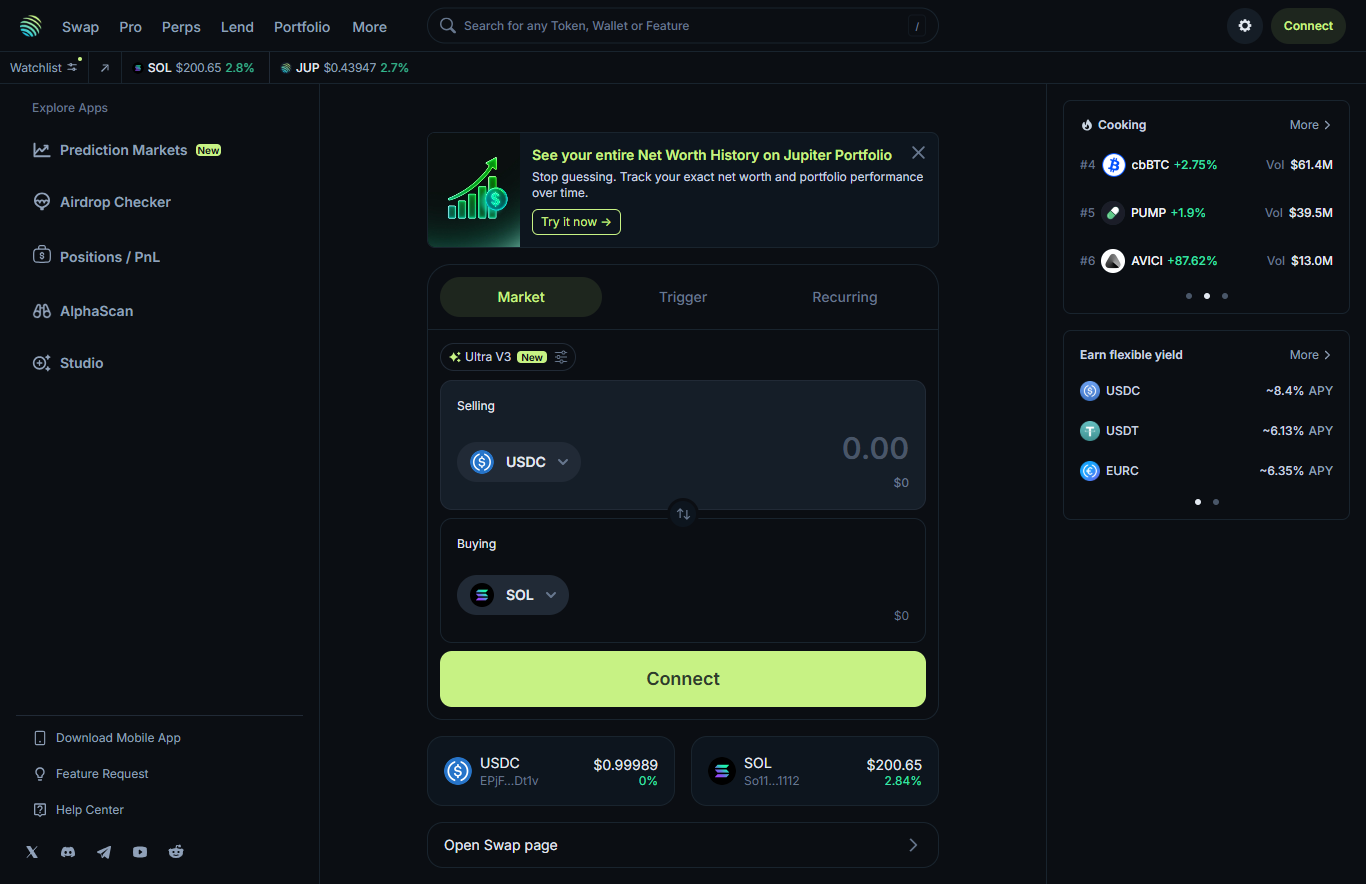
Jupiterswap fees can be estimated by reading the quote panel carefully before approving the transaction. The expected output amount is the first number most people notice, but it should not be the only number checked. Users should also look at price impact, route, slippage, minimum received amount, network fee estimate, token account changes, and any product fee displayed by the interface.
Jupiterswap fees become clearer when users compare the same trade size across a few settings. A small swap may show a modest network cost but a large percentage impact if the token is illiquid. A larger swap may route through several pools and create a better average price than expected, or it may push the market harder. Splitting trades is sometimes discussed by traders, but it can add extra transactions and does not guarantee a better outcome.
Connect the intended Solana wallet and confirm it is on the correct site or app.
Select the input token, output token, and trade size.
Review the quoted output, price impact, and minimum received amount.
Open route or settings details if available, especially for thinly traded tokens.
Check the wallet confirmation for network fees and account changes before signing.
Jupiterswap fees should be checked again if the quote refreshes. Crypto markets can move in seconds, and Solana transactions depend on recent blockhashes and current network conditions. If a user steps away, changes wallet tabs, or waits during volatility, the earlier preview may no longer describe the final transaction accurately.
Why can Jupiterswap fees feel higher than expected?
Jupiterswap fees can feel higher than expected when users treat every difference as a direct fee. The most common surprise is price impact. If a token has shallow liquidity, the route may need to accept a worse marginal price to fill the order. That cost is economic slippage from the pool, not necessarily a commission charged by the interface.
Jupiterswap fees can also look confusing when SOL is needed for network activity. A wallet with tokens but almost no SOL may fail to swap because Solana transactions require SOL for fees. Users who are new to Solana sometimes assume the input token can always pay for everything. In many on-chain workflows, a small SOL balance is still necessary for transaction execution.
Jupiterswap fees may appear different across wallets because wallets display transaction details in different ways. One wallet may highlight estimated network fees, another may show token account creation, and another may summarize the full transaction less clearly. The safer approach is to read both the Jupiter quote and the wallet confirmation, then stop if the requested approval does not match the intended trade.
Jupiterswap fees can rise during heavy activity when users choose higher priority. Fast-moving token launches, meme coins, NFT-related activity, or major market events can make transaction delivery more competitive. Paying more for priority does not guarantee profit or a better trade; it only relates to how the transaction is submitted and prioritized.
How do Jupiterswap fees compare with centralized exchanges and other DEX routes?
Jupiterswap fees are different from centralized exchange fees because the user is interacting with on-chain liquidity through a self-custody wallet. A centralized exchange may charge a visible trading fee and hide some costs in spread, withdrawal fees, or custody risk. Jupiter exposes the trade as a wallet transaction, which can make costs more transparent but also more technical.
Jupiterswap fees can be competitive when aggregation finds a better route than a single pool. Instead of manually checking several Solana DEX interfaces, a user can let Jupiter compare liquidity sources. That said, aggregation is not magic. If the entire market for a token is thin, volatile, or risky, a route search cannot create deep liquidity that does not exist.
Jupiterswap fees should also be compared with the cost of bridging, depositing, or withdrawing elsewhere. A trade that looks cheaper on another chain or exchange may require extra steps, custody risk, bridge risk, or withdrawal delay. On the other hand, large traders may still compare centralized order books, OTC desks, aggregators, and direct pool routes before choosing where to execute.
Dynamic execution details and possible product fee
Simpler flow with less manual control
Centralized exchange
Trading fee, spread, deposit and withdrawal rules
Convenience but custodial exposure
Single DEX pool
Pool fee and price impact
Direct route but less route comparison
Jupiterswap fees are best compared by total received amount after all steps, not by one fee label. A user who only compares a nominal percentage may miss withdrawal fees, bridge costs, worse spreads, or failed transaction attempts.
What safety checks matter before paying Jupiterswap fees?
Jupiterswap fees are only one part of safe trading. Users should verify the official domain or app entry point, confirm the token mint address when trading unfamiliar assets, and avoid signing approvals they do not understand. Fake tokens can copy names and tickers, and malicious sites can imitate a swap interface. Self-custody gives users control, but it also makes careful verification essential.
Jupiterswap fees should be reviewed alongside token risk. A low-fee route into a token with frozen liquidity, suspicious mint permissions, or extreme volatility is not a good result just because the swap cost looks small. Users should research token contracts, liquidity depth, holder concentration, and project credibility before trading. This page is informational and does not provide financial advice or guarantee trading outcomes.
Jupiterswap fees can also interact with wallet security. Hardware wallets, transaction simulation, spending limits, and trusted browser hygiene can reduce avoidable mistakes. Users should be cautious with unknown extensions, unsolicited links, and urgent messages claiming that a swap must be completed immediately. A legitimate fee preview should never require sharing a seed phrase.
Jupiterswap fees should be verified with official sources because fee policies, product names, and trading modes can change. A static article can explain the structure, but the live interface and official documentation are the places to confirm current values. For a safety-focused companion topic, the can help users think beyond the fee line.
How should beginners think about Jupiterswap fees before their first trade?
Jupiterswap fees are easier for beginners when the first trade is small and simple. A small test swap can show how the wallet prompt, output estimate, network cost, and confirmation process work. The goal is not to optimize every basis point immediately. The goal is to understand what information appears before signing and what changes after the transaction confirms.
Jupiterswap fees should be judged in relation to trade size. A tiny network fee may be negligible on a larger trade but noticeable on a very small swap. Conversely, a large trade may make price impact the dominant cost even if the network fee is small. Beginners should avoid assuming that a route suitable for one amount is suitable for every amount.
Jupiterswap fees also require enough SOL in the wallet. Before swapping SPL tokens, users should keep a small SOL balance for transaction fees and possible account actions. If a wallet is nearly empty of SOL, failed transactions and confusing prompts become more likely. The cleanest habit is to maintain fee SOL separately from the token amount being traded.
Jupiterswap fees are part of a broader decision: whether the trade is necessary, whether the token is liquid, whether the user understands the risk, and whether the expected output is acceptable. A well-read confirmation screen is better than a rushed signature. Crypto transactions can be irreversible, and no interface can remove all trading risk.
When are Jupiterswap fees worth paying?
Jupiterswap fees may be worth paying when the route gives a clear, acceptable output and the user understands the risks. For many Solana users, Jupiter's value is route discovery: it can compare liquidity sources quickly and reduce the manual work of checking multiple DEX venues. That convenience has value, but it should still be measured against the final quote.
Jupiterswap fees are not worth paying blindly. If the price impact is high, the token looks suspicious, the wallet prompt is unclear, or the route changes unexpectedly, pausing is reasonable. There will usually be another opportunity to trade, and avoiding a bad transaction is often more valuable than saving a few seconds.
Jupiterswap fees ultimately make the most sense when users focus on total execution quality. That means checking the output amount, understanding network and priority costs, choosing settings intentionally, and verifying current fee rules with official Jupiter information. The strongest habit is simple: never sign a swap until the cost, token, route, and risk all match the user's intent.
Reader rating:
4.9 / 5
based on 454 ratings
Questions and Answers
What are Jupiterswap fees?
Jupiterswap fees are the costs that may apply when swapping through Jupiter on Solana. They can include Solana network fees, optional priority or Jito-related costs, and product-specific Jupiter charges depending on the mode or feature used. Users should also consider price impact and slippage, which affect trade outcome even when they are not direct platform fees.
Does Jupiter charge a fee for every swap?
Jupiter fee treatment depends on the trading mode and product. Manual market swaps are generally different from Ultra, limit orders, recurring orders, and perps. A user may still pay Solana network fees even when there is no Jupiter commission on a specific manual swap. Always check the current quote and wallet confirmation before approving a transaction.
Why do Jupiterswap fees change between trades?
Jupiterswap fees can change because network conditions, routing, trade size, token liquidity, slippage settings, and priority options change. A small liquid swap may show low cost, while a larger or thinly traded token can have more price impact. If the quote refreshes, users should re-check the expected output and fee details before signing.
Are slippage and Jupiterswap fees the same thing?
Slippage and Jupiterswap fees are related but not the same. A fee is a cost such as a network charge, priority cost, or product commission. Slippage is the amount of price movement a user allows before a swap fails or executes within the accepted range. Both can affect the final amount received, so both should be reviewed.
How can I reduce Jupiterswap fees?
Users can reduce avoidable costs by comparing trade sizes, checking price impact, avoiding unnecessary priority settings, keeping enough SOL for network fees, and trading liquid pairs when possible. Smaller test swaps can help beginners understand the process, but repeated tiny swaps may add extra transaction costs. The best approach is to review the full quote rather than chasing one fee number.
Do I need SOL to pay Jupiterswap fees?
In most Solana wallet workflows, users need SOL to pay network fees for transactions. Even if the swap uses another token as the input, the blockchain transaction itself generally requires SOL. Some interfaces may abstract parts of the process, but keeping a small SOL balance helps avoid failed transactions and confusing wallet prompts.
Is paying Jupiterswap fees safe?
Paying Jupiterswap fees is not the main safety issue; signing the correct transaction is. Users should verify the official app or domain, check token mint addresses for unfamiliar assets, review wallet prompts, and avoid suspicious links. Crypto swaps can be irreversible, and low fees do not make a risky token or malicious site safe.
Jupiter Swap acts as a decentralized exchange (DEX) designed for swapping various cryptocurrencies seamlessly. Its growing popularity stems from the innovative solutions it offers for liquidity and transaction efficiency. By leveraging smart contracts, traders can execute transactions at high speeds while maintaining security.
What Sets Jupiter Swap Apart?
The uniqueness of Jupiter Swap lies in its integration with various blockchain networks, offering users flexibility and a wide range of asset options. Unlike centralized exchanges, Jupiter Swap minimizes counterparty risk, which appeals to users looking for more secure trading environments. Additionally, its intuitive design caters to both novice and experienced traders.
Benefits of Jupiter Swap
Opting for Jupiter Swap for trades comes with several advantages:
Lower transaction fees compared to traditional exchanges.
Fast and secure transactions using blockchain technology.
Access to a diverse range of cryptocurrencies and tokens.
User-friendly interface suitable for all skill levels.
Enhanced privacy, as no personal information is required.
How to Use Jupiter Swap
Getting started with Jupiter Swap is straightforward. Users need to connect their crypto wallets, select the trading pair they want, and execute the swap. The platform provides real-time data on prices, making it easier to make informed decisions. It’s recommended to familiarize yourself with the interface and available trading tools to maximize your efficiency.
A Comparison with Other Exchanges
When comparing Jupiter Swap with other trading platforms, several factors come into play, such as fees, supported assets, and user experience. Here’s a quick comparison: