Jupiterswap: Solana Swap Routing and Trading Guide
Jupiterswap Is a Solana Swap Routing Guide for Everyday Traders
Jupiterswap Is a way many users describe swapping through Jupiter, the Solana routing interface at jup.ag. It helps traders compare token routes, estimate fees, manage slippage, and send swaps from a connected wallet without manually checking every Solana decentralized exchange. This guide explains what Jupiterswap does, how the workflow usually feels, where it can help, and which risks users should verify before approving any transaction.
Jupiterswap matters because Solana trading is spread across many liquidity venues. A token pair may have liquidity on Raydium, Orca, Meteora, Phoenix, or another market, and the best price can move quickly. Instead of asking a user to choose one pool by hand, Jupiter-style routing looks across available sources and presents a route that aims to improve execution. Jupiterswap is therefore best understood as a routing experience, not simply as one isolated exchange.
What is Jupiterswap?
Jupiterswap is commonly used as a shorthand for using Jupiter to swap tokens on Solana. Jupiter is known as an aggregator, which means it searches across multiple decentralized trading venues and attempts to find an efficient path for a trade. If a user wants to exchange SOL for USDC, a memecoin, a liquid staking token, or another Solana Program Library asset, Jupiterswap can help surface available routes from one interface.
Jupiterswap does not remove the need to understand wallet permissions, token selection, price impact, or transaction approval. It gives the user a clearer front end for a fragmented market. The practical value is convenience: one place to compare a quote, inspect the expected output, adjust settings, and approve a transaction through a Solana wallet such as Phantom, Solflare, Backpack, or another compatible wallet.
The protocol behind the experience is especially useful when liquidity is split. A single token can trade across several pools with different prices and depths. Jupiterswap may route through one venue or split the order across multiple venues when that appears more efficient. That routing logic is the main reason people compare Jupiterswap with standalone Solana DEX interfaces rather than treating it as only another swap screen.
How does Jupiterswap work on Solana?
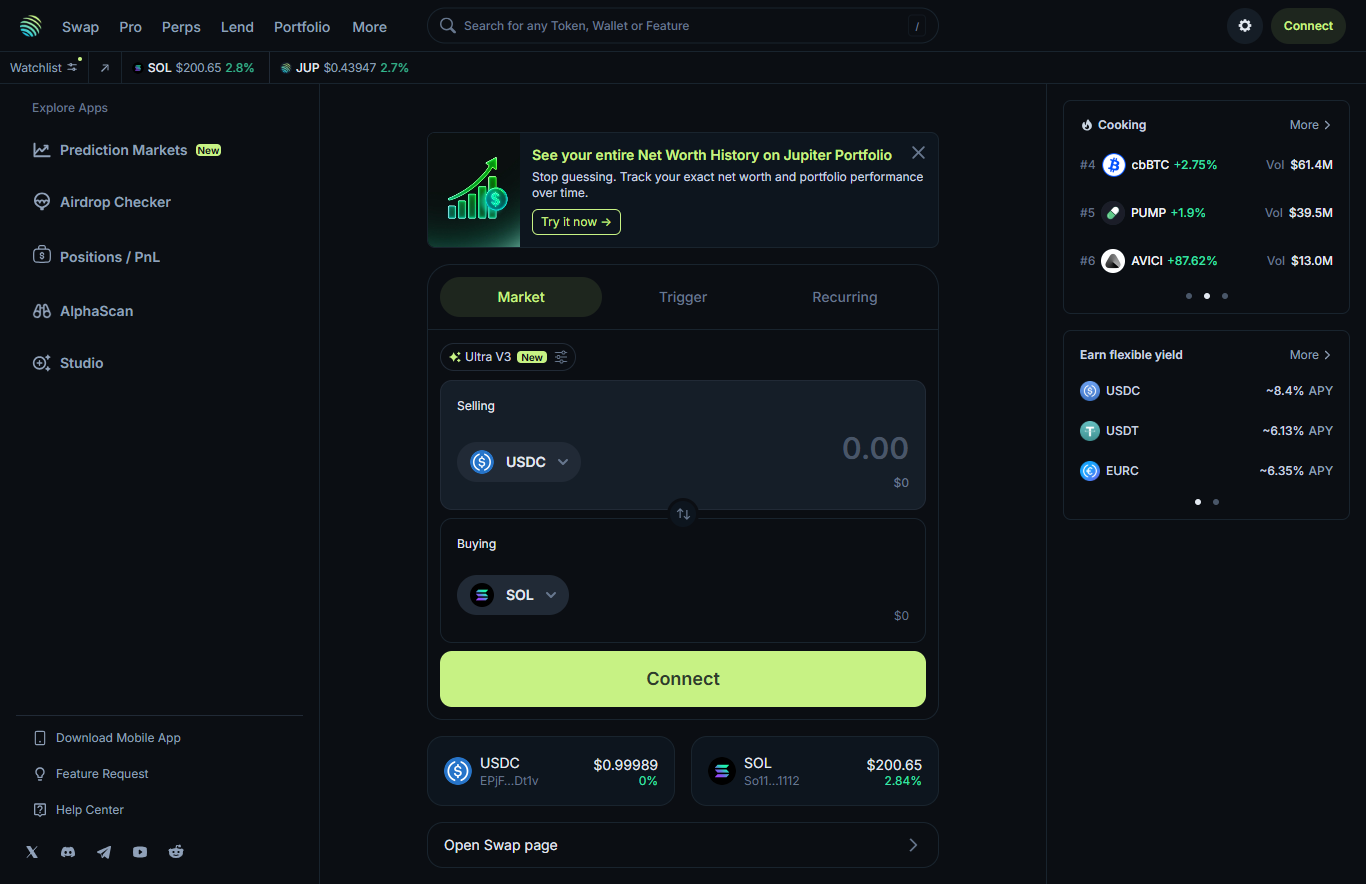
Jupiterswap begins with a quote. The user selects the token they want to pay, the token they want to receive, and the amount. Jupiter then checks available liquidity paths and returns an estimated output. In practice, Jupiterswap may evaluate direct pools, multi-hop routes, and combinations of venues, depending on the pair and current market conditions.
Jupiterswap still depends on Solana network conditions and on the quality of liquidity in the market. If a token has shallow liquidity, the route may show high price impact. If a pool is moving quickly, the final output may differ from the first quote. The interface usually gives the user a chance to review slippage tolerance, route details, platform fees where applicable, and the wallet transaction before signing.
For a new user, the important distinction is that Jupiterswap does not custody funds in the same way a centralized exchange account might. The swap is approved from the connected wallet, and the user remains responsible for wallet security. That is useful for self-custody, but it also means the user must be careful with fake websites, malicious token pages, and approval prompts that do not match the intended trade.
What can you use Jupiterswap for?
Jupiterswap is most often used for simple token swaps, but its role can extend into several trading workflows. A user might swap SOL into USDC, rotate between Solana ecosystem tokens, buy a new token after checking its contract details, or exit a position back into SOL. Jupiterswap can also be part of a broader DeFi routine that includes portfolio tracking, limit orders, dollar cost averaging, and liquidity research.
Jupiterswap is not limited to expert traders. Many casual users open it because they want a clean way to move between assets without visiting every DEX individually. More advanced users may care about route quality, price impact, priority fees, and execution speed. Both groups benefit from the same core idea: Solana liquidity is easier to use when the routing layer can search several sources at once.
Common Jupiterswap use cases include:
Swapping SOL, USDC, and other Solana tokens from a connected wallet.
Comparing estimated output across available liquidity routes.
Reducing manual checks across individual DEX platforms.
Reviewing slippage and price impact before approving a trade.
Using related tools such as limit orders or DCA where available.
Jupiterswap can also sit beside other Solana resources. Users who want to understand pool-based trading may compare it with an internal guide to , while users focused on wallet protection may benefit from a separate look at or other custody options. Those comparisons should support research, not replace checking official sources.
How to get started with Jupiterswap
Jupiterswap usually starts with wallet preparation. A user needs a Solana-compatible wallet, enough SOL for network fees, and the correct token accounts for the assets involved. Before connecting, the user should confirm they are on the official Jupiter domain and not on a lookalike page. Fake sites are a major crypto risk, especially when a popular swap interface has a familiar name.
Jupiterswap then follows a straightforward path. Connect the wallet, choose the token to pay, choose the token to receive, enter the amount, and review the quote. The user should check the token symbol, token address when needed, estimated output, price impact, slippage setting, and any warning shown by the interface. Only after those details make sense should the user approve the wallet transaction.
Jupiterswap confirmations happen in the wallet and on the Solana network. The wallet approval screen is not a formality; it is the final checkpoint before the transaction is signed. If the wallet prompt shows an unexpected asset, a suspicious permission, or an amount that differs from the intended trade, canceling is usually the safer action. After approval, users can inspect the completed transaction in a Solana block explorer.
Fees, slippage, and price impact on Jupiterswap
Jupiterswap can feel inexpensive because Solana network fees are often small compared with many other chains, but swaps are not free of cost. A trade may involve network fees, priority fees, route-specific costs, and market effects. The most visible cost for many users is not a line-item fee but slippage and price impact, especially on volatile or thinly traded tokens.
Jupiterswap slippage settings define how much worse the execution can be before the transaction fails. A very tight slippage tolerance may protect the user from a poor fill, but it may also cause failed transactions in fast markets. A very loose setting may help the transaction complete, but it can expose the user to a worse result than expected. There is no universal best setting, because the right choice depends on token liquidity, volatility, and trade size.
Jupiterswap price impact is different from normal price movement. Price impact refers to how much the trade itself moves through the available liquidity. A large order in a shallow pool can receive a much worse average price than the current displayed price. The quote screen should be treated as a decision tool: if price impact looks high, reducing trade size or waiting for better liquidity may be more prudent.
Is Jupiterswap safe to use?
Jupiterswap can be useful, but safety depends on more than the interface. Users should verify the official domain, inspect wallet prompts, avoid unsolicited support messages, and never share a seed phrase. A legitimate swap flow should not require a recovery phrase, private key, or secret phrase. Any page or person asking for those details should be treated as hostile.
Jupiterswap also carries normal DeFi risks. Smart contracts can have bugs, routes can fail, liquidity can disappear, and tokens can be malicious or worthless. Even when the routing layer works correctly, it cannot make a bad token safe. Users should research token contracts, supply distribution, liquidity locks where relevant, trading history, and official project channels before swapping into unfamiliar assets.
In practice, Jupiterswap safety improves when users build a repeatable routine. Bookmark the official site after verifying it. Test small trades before moving larger amounts. Keep enough SOL for fees. Read every wallet prompt. Revoke unnecessary permissions when appropriate. Separate long-term holdings from active trading wallets. These habits do not eliminate risk, but they reduce common mistakes that lead to avoidable losses.
Jupiterswap compared with Solana DEX alternatives
Jupiterswap is often compared with Raydium, Orca, Meteora, and Phoenix, but the comparison is not one-to-one. Raydium and Orca are known for liquidity pools and direct swap experiences. Meteora focuses on liquidity systems that can support different market conditions. Phoenix brings order book style trading to Solana. Jupiterswap connects to venues like these to search for execution routes.
Jupiterswap can therefore complement other platforms rather than replacing them. A liquidity provider may care deeply about a specific pool on Raydium or Orca. A trader who wants a fast quote across venues may prefer the aggregator route. A user who needs order book behavior may look at venues that specialize in that structure. The right tool depends on the job, the token, and the user's tolerance for complexity.
Tool type
Typical strength
Best fit
Jupiterswap routing
Aggregates liquidity across venues
Users seeking efficient swap quotes
Pool-based DEX
Direct liquidity pool access
Swaps and liquidity provision
Order book market
Price levels and order placement
Users who prefer order book trading
Trading bot interface
Speed and automation
Experienced users with higher risk tolerance
Jupiterswap may not be the fastest choice for every speculative token trade. Some traders use specialized bots or terminals when milliseconds matter, but those tools introduce their own risks, permissions, and learning curves. For many everyday Solana swaps, Jupiterswap remains a practical balance of route discovery, usability, and wallet-based control.
Benefits of using Jupiterswap responsibly
Jupiterswap offers the clearest benefit when a user wants a broad market view without opening multiple tabs. The aggregator can reduce friction by presenting a route, an estimated return, and key trade settings in one place. This is especially helpful for users who do not know which DEX currently has the best liquidity for a specific pair.
Jupiterswap also makes trade review more structured. The quote, route, slippage tolerance, and wallet confirmation create a sequence of checkpoints. That does not guarantee a profitable result, and it does not protect against every token risk, but it helps users slow down enough to notice obvious problems. In crypto, the ability to pause before signing is a real advantage.
Jupiterswap can be part of a disciplined workflow for users who trade regularly. A careful trader may compare the quote with other market data, avoid oversized trades in low-liquidity tokens, and keep records for tax or portfolio tracking. None of those practices require predicting the market. They simply make the mechanics of swapping more transparent.
Common Jupiterswap mistakes to avoid
Jupiterswap users often run into problems when they rush. The most common mistake is selecting the wrong token because a symbol is duplicated or misleading. Token symbols are not unique, and malicious tokens can imitate popular names. Checking the contract address through official project channels can prevent many bad swaps before they happen.
Jupiterswap mistakes also include ignoring price impact, setting slippage too high, approving unexpected wallet prompts, and leaving no SOL for follow-up fees. Another frequent issue is assuming that a quote is a promise. A quote is an estimate based on current conditions. If liquidity changes or the network becomes congested, the transaction can fail or execute differently within the allowed settings.
Jupiterswap should be used with the same caution as any DeFi tool. Avoid trading based on hype alone. Be careful with newly launched tokens. Treat screenshots and social claims as unverified until checked against primary sources. Keep security software and wallet extensions updated. Most importantly, do not send funds or reveal wallet secrets to anyone claiming they can fix a failed swap.
Where Jupiterswap fits in a Solana trading routine
Jupiterswap fits best as a routing and execution layer for users who already understand the basics of self-custody. It can simplify the act of swapping, but it does not decide whether a token is worth buying, whether a trade size is appropriate, or whether a project is legitimate. Those decisions remain with the user.
Jupiterswap is strongest when paired with verification. Check the official Jupiter interface, compare token details, review the route, and read the wallet approval screen. If the trade involves meaningful money, take more time. Crypto markets move quickly, but rushed approvals are one of the easiest ways to make permanent mistakes.
Jupiterswap is ultimately a practical tool for navigating Solana liquidity. It helps users access routes across the ecosystem, estimate swap outcomes, and manage common trade settings from a wallet-connected interface. Used carefully, Jupiterswap can make everyday Solana swaps clearer and more efficient. Used carelessly, it carries the same risks as the wider DeFi environment, so every transaction should be verified through official sources before approval.
Reader rating:
4.9 / 5
based on 454 ratings
Questions and Answers
What is Jupiterswap used for?
Jupiterswap is commonly used to describe swapping tokens through Jupiter on Solana. It helps users compare routes across decentralized liquidity sources, review estimated output, adjust slippage, and approve trades from a connected wallet. It is useful for SOL, USDC, ecosystem tokens, and other supported Solana assets, but users still need to verify token details and transaction prompts.
Is Jupiterswap the same as Jupiter on jup.ag?
Jupiterswap is often a user shorthand for the swap experience associated with Jupiter, whose official Solana interface is commonly known through jup.ag. The name can also appear informally in searches, so users should be careful with spelling, domains, and lookalike sites. Always verify the official source before connecting a wallet or approving a transaction.
How does Jupiterswap find better swap routes?
Jupiterswap works through aggregator-style routing. Instead of relying on one liquidity pool, it can check multiple Solana trading venues and estimate a route for the selected token pair. Depending on liquidity, a route may use one venue or split across sources. The displayed quote is still an estimate, so slippage, price impact, and final wallet approval remain important.
What fees should I expect when using Jupiterswap?
Users may encounter Solana network fees, optional priority fees, route-related costs, and market effects such as slippage or price impact. The largest practical cost on a volatile or thinly traded token may be the execution difference rather than the base network fee. Review the quote, trade size, price impact, and wallet confirmation before signing any swap.
Is Jupiterswap safe for beginners?
Jupiterswap can be approachable for beginners because it presents routing, token selection, and trade confirmation in a single workflow. However, it is still a DeFi tool connected to a self-custody wallet. Beginners should start small, confirm the official site, never share seed phrases, check token addresses, and cancel any wallet prompt that does not match the intended trade.
Why did my Jupiterswap transaction fail?
A Jupiterswap transaction may fail if the price moves beyond the slippage setting, liquidity changes before confirmation, the wallet lacks enough SOL for fees, or the network is congested. Failed transactions are common in fast markets and do not always mean the tool is broken. Review the error, adjust settings carefully, and avoid raising slippage without understanding the risk.
How is Jupiterswap different from a standalone Solana DEX?
A standalone Solana DEX usually gives direct access to its own pools, order books, or liquidity systems. Jupiterswap is different because it focuses on routing across multiple venues. That can help users compare execution from one interface, while direct DEX platforms may be better for liquidity providers, pool-specific research, or users who want a particular trading model.
Jupiter Swap acts as a decentralized exchange (DEX) designed for swapping various cryptocurrencies seamlessly. Its growing popularity stems from the innovative solutions it offers for liquidity and transaction efficiency. By leveraging smart contracts, traders can execute transactions at high speeds while maintaining security.
What Sets Jupiter Swap Apart?
The uniqueness of Jupiter Swap lies in its integration with various blockchain networks, offering users flexibility and a wide range of asset options. Unlike centralized exchanges, Jupiter Swap minimizes counterparty risk, which appeals to users looking for more secure trading environments. Additionally, its intuitive design caters to both novice and experienced traders.
Benefits of Jupiter Swap
Opting for Jupiter Swap for trades comes with several advantages:
Lower transaction fees compared to traditional exchanges.
Fast and secure transactions using blockchain technology.
Access to a diverse range of cryptocurrencies and tokens.
User-friendly interface suitable for all skill levels.
Enhanced privacy, as no personal information is required.
How to Use Jupiter Swap
Getting started with Jupiter Swap is straightforward. Users need to connect their crypto wallets, select the trading pair they want, and execute the swap. The platform provides real-time data on prices, making it easier to make informed decisions. It’s recommended to familiarize yourself with the interface and available trading tools to maximize your efficiency.
A Comparison with Other Exchanges
When comparing Jupiter Swap with other trading platforms, several factors come into play, such as fees, supported assets, and user experience. Here’s a quick comparison: